
Productize expertise.
Automate the practice.
Manage margin.
Explore how AI and workflows connect customer selection, proposals, consulting delivery, follow-up and support. Plan IP-In / IP-Out and connect each engagement to its margin.
An Applied AI Series reference design by João Frederico Neto. Hosted by Alsvior Global.
Illustrative blueprint · synthetic records · no live customer systems
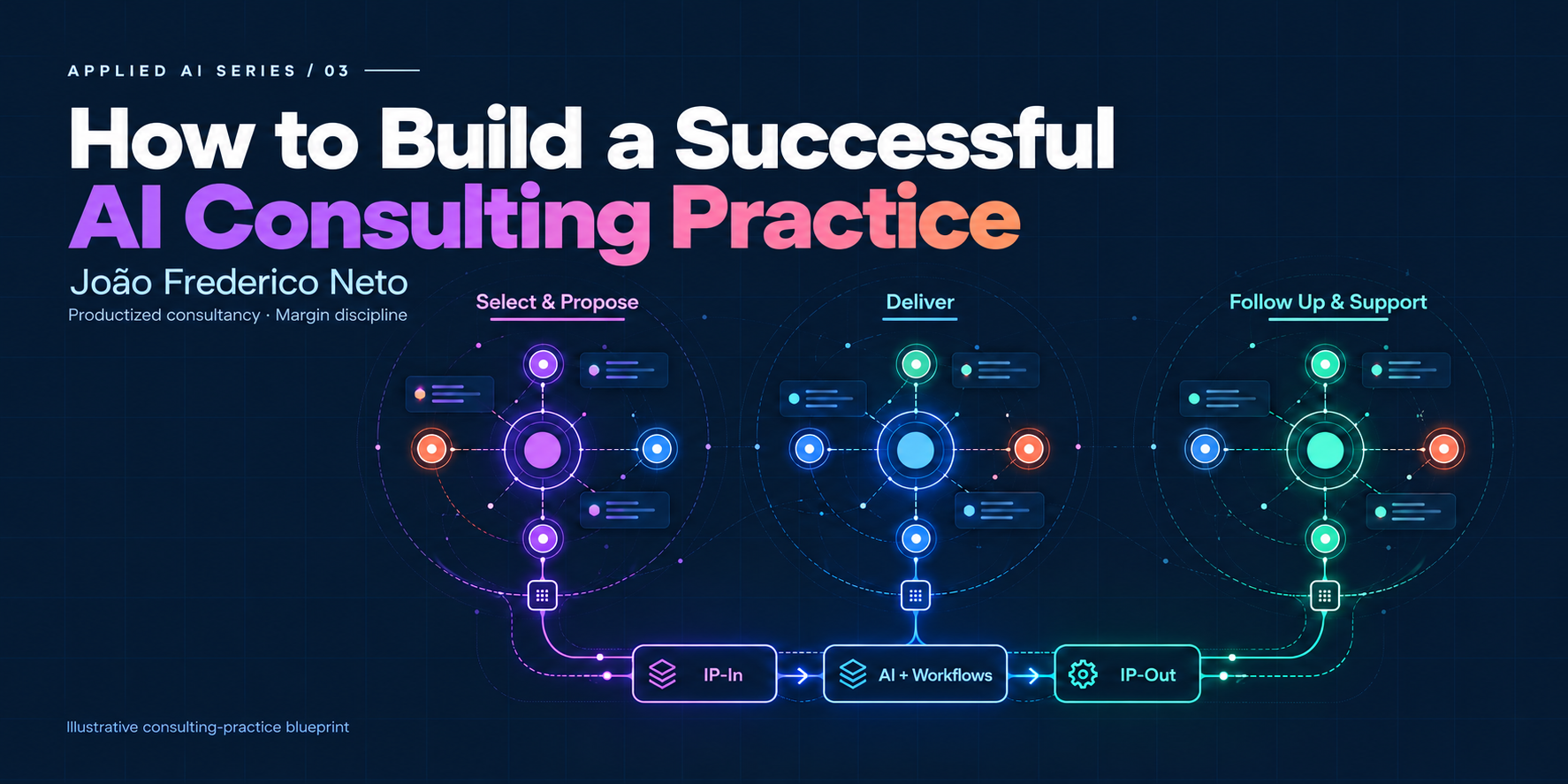 ONE PRACTICE / FIVE STAGES / REVIEWED CAPABILITY
Choose a defined offer, keep a traceable record through the lifecycle, and review what can safely become reusable capability.
Define the service before automating it.
Illustrative catalogue entry for B2B software providers. These are scoped package types in a reference design, not announced Alsvior products.
One opportunity. Five connected stages.
OPP-SYN-104 becomes ENG-SYN-104 after approval. The same synthetic record carries the proposal baseline and IP plan into delivery, follow-up and support.
Customer selection
Accountable owner: Commercial lead
Permitted company signals, discovery notes and catalogue fit criteria
Summarise signals, match the catalogue and draft discovery questions
Apply fit rules, mark missing inputs and route the opportunity
Qualified opportunity OPP-SYN-104 with reasons and a challenge route
Catalogue and qualification rubric used as approved IP-In
Fit and expected delivery effort tested before a proposal
Workflows coordinate state, rules and permissions. AI interprets, proposes and explains. People approve consequential commitments, audit outcomes and take over when needed. All displayed records are synthetic artefacts.
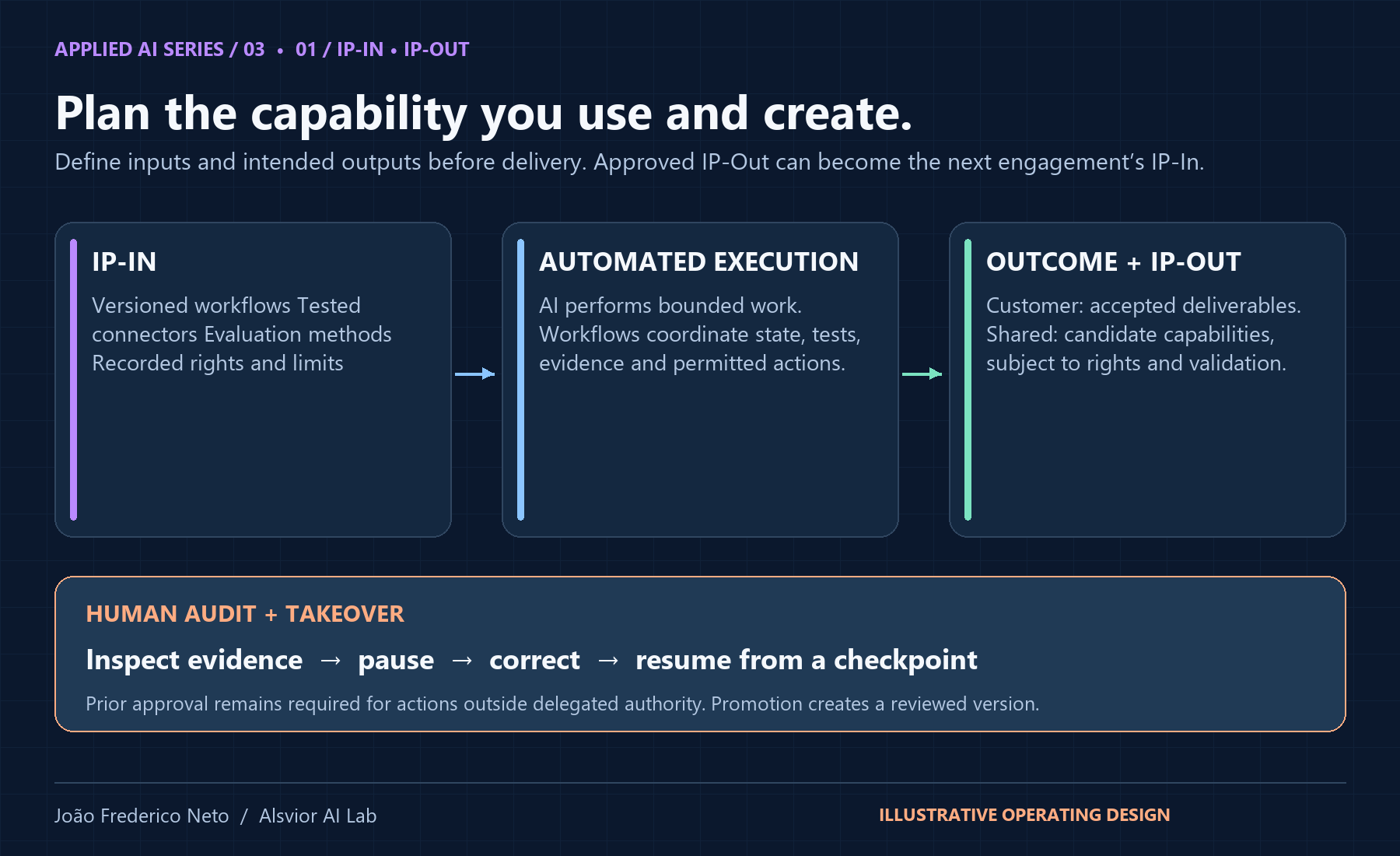
Plan what enters and what may leave.
Versions are pinned for ENG-SYN-104. Customer records remain in a separate private context. A candidate becomes reusable only after rights, tests and ownership review.
Versioned capability
- Requirements schema v1.2 · approved structure
- Configuration workflow v2.0 · pinned sequence
- Tested connector v1.4 · licensed synthetic use
- Evaluation suite v1.1 · synthetic tests
Source and permitted use are recorded; the delivery lead maintains the pinned set.
Evidence travels with work
Approved scope → bounded preparation → tests → acceptance. A person can audit, pause or take over. No live credentials or customer systems are present.
Inspect the run ↓Two destinations
- Customer: configured workspace and accepted handover · customer-specific
- Shared candidate: conflict-detection improvement and connector update · pending rights and regression review
Each output needs source, owner, recipient, acceptance, permitted use, maintainer and version.
Let the standard path run. Keep authority visible.
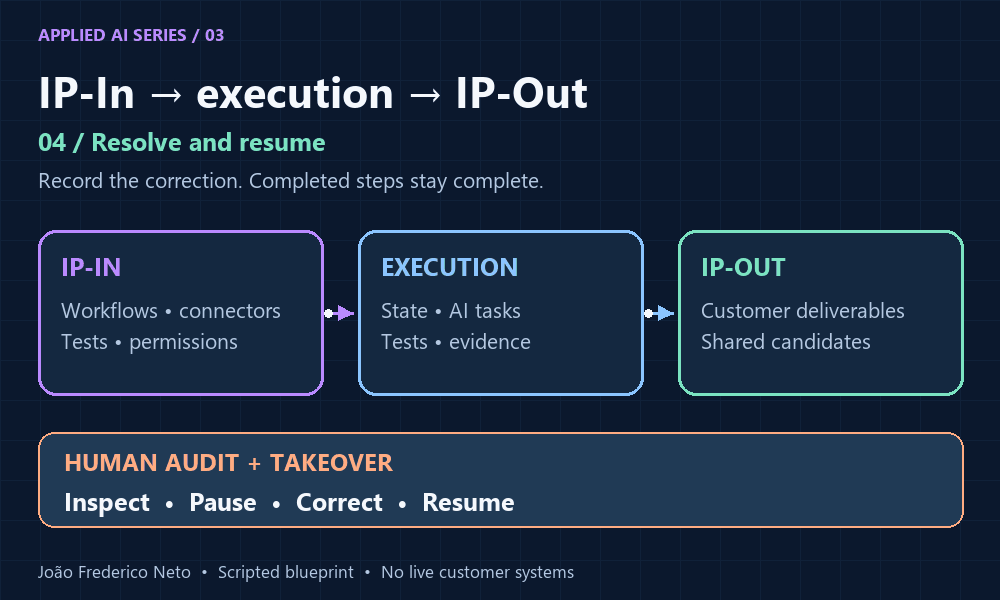
Fully automated execution within agreed boundaries, with human audit and takeover. This scripted run demonstrates interface behaviour, not production performance.
Ready. No actions have run.
Execution checkpoints
- 01Approved requirements and pinned IP-In 1.2 / 2.0 / 1.4 / 1.1
- 02AI interprets synthetic requirements; workflow checks scope
- 03Sandbox configuration prepared under approved authority
- 04Evaluation suite checks resulting state and acceptance
- 05Simulated handover accepted; invoice draft prepared
- 06Candidate IP-Out recorded for separate review
Event history
Cost used: £0 of £12. Each step is recorded once.
No actions recorded yet.
Review input references, actions, evaluations, costs and intervention. Audit follows execution; it never substitutes for required prior approval.
Promotion gate
A completed run creates a candidate, not approved reusable IP. Select each verified check to see the gate.
Promotion blocked: run incomplete; ownership and permitted reuse recorded; customer-specific material removed; regression and interface tests pass; named maintainer assigned; successor version and compatibility recorded.
View the illustrated sequence
The accessible execution controls above are the functional demo. This optional animation is editorial.
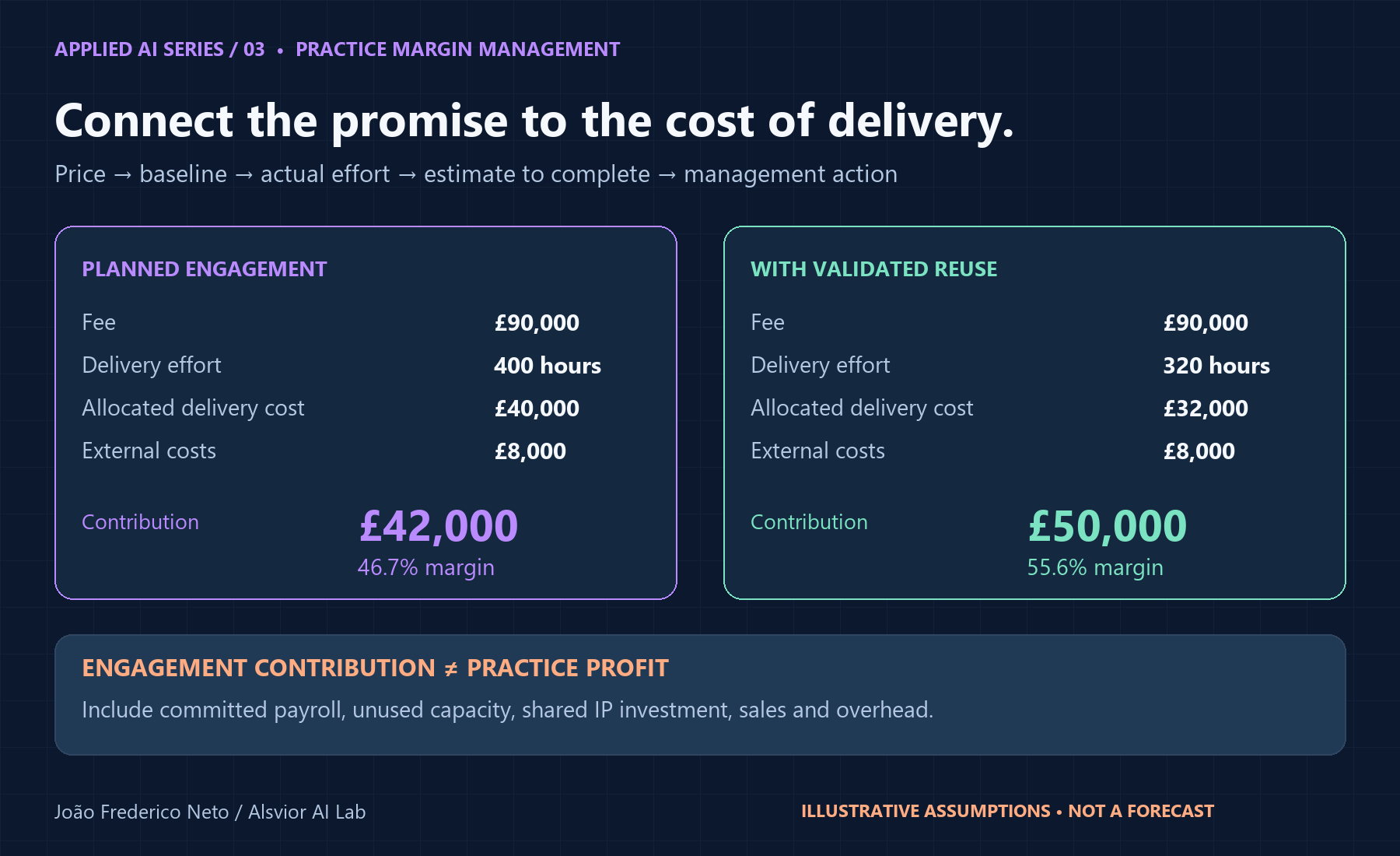
Connect the work to its contribution.
ENG-SYN-104 · hypothetical fee and allocated costs. Hours include adaptation, review, audit, takeover and relevant support. This is an educational before/after comparison, not a live forecast.
Change the assumptions
Allocated contribution
Difference: £8,000 · 8.9 percentage points
See the default example as a diagram
This static illustration shows the supplied £90,000 / 400-hour / 320-hour assumptions. The interactive figures above reflect your current inputs.
ENG-SYN-104 management record
Approved baseline: 400 h / £90,000 fee. Actual-to-date: illustrative 160 h at £100/h. Remaining estimate: 160 h. Expected allocated contribution using the revised total: £50,000.
Currency: GBP. Data state: Illustrative fields complete. Action owner: Delivery lead. Scope or staffing changes require named approval and retained history.
EMS is the proposed engagement management layer. A production forecast would recalculate from verified actuals plus remaining estimate. AI, infrastructure, integration, rework, support and shared IP must be allocated once; these figures do not represent cash collected.
Reconcile the complete cost base.
Three accepted illustrative engagements in one planning period. Engagement contribution above is an allocated measure; the company remainder below includes committed payroll, shared development, central cost and overflow. Released hours do not automatically remove payroll.
Engagement 01
520 h · £30,000 allocated contribution · 33.3% margin
Engagement 02
400 h · £42,000 allocated contribution · 46.7% margin
Engagement 03
320 h · £50,000 allocated contribution · 55.6% margin
Company commitments and cost reconciliation
- Committed payroll
- £150,000
- External cost
- £24,000
- Overflow cost · 0 h
- £0
- Shared development + central
- £60,000
- Operating remainder
- £36,000
Allocated contributions total £122,000. Less unused committed capacity £26,000 and shared/central costs £60,000 = £36,000. The two totals reconcile without counting payroll twice.
The comparison holds fees and company commitments constant; it does not measure AI causality or create extra revenue. Tax, financing, working capital, cash timing and other unmodelled costs are excluded. Remainder is not cash, EBITDA, ROI or guaranteed profit.
Start with one outcome and its economics.
Bring an outcome, a workflow and the capabilities you want to build. The worksheet captures authority, acceptance, IP rights, cost and promotion decisions.